
Authors:
Gert-Jan Stads and Luis de los Santos
Year:
2023
Publisher
ASTI, The Inter-American Development Bank (IDB), International Food Policy Research Institute (IFPRI).
Back to:
Severe underinvestment
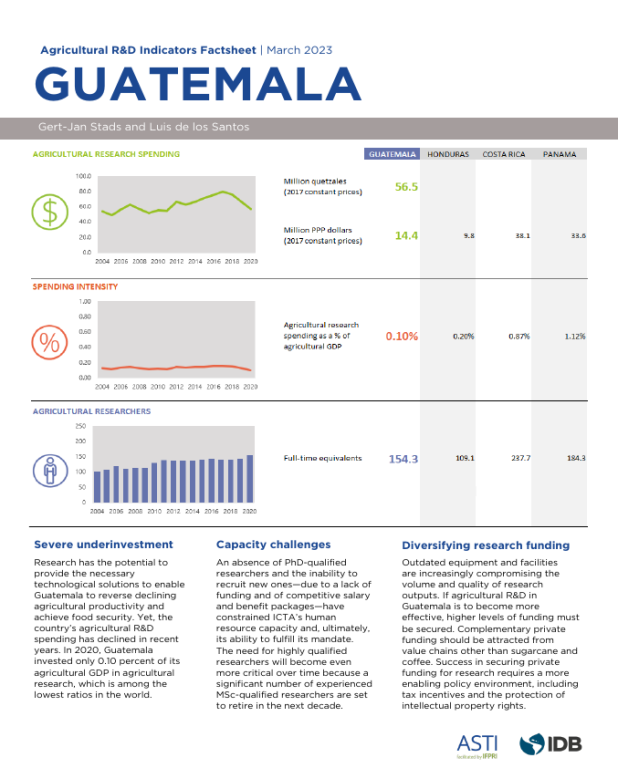
Research has the potential to provide the necessary technological solutions to enable Guatemala to reverse declining agricultural productivity and achieve food security. Yet, the country’s agricultural R&D spending has declined in recent years. In 2020, Guatemala invested only 0.10 percent of its agricultural GDP in agricultural research, which is among the lowest ratios in the world.
Capacity challenges
An absence of PhD-qualified researchers and the inability to recruit new ones—due to a lack of funding and of competitive salary and benefit packages—have constrained ICTA’s human resource capacity and, ultimately, its ability to fulfill its mandate. The need for highly qualified researchers will become even more critical over time because a significant number of experienced MSc-qualified researchers are set to retire in the next decade.
Diversifying research funding
Outdated equipment and facilities are increasingly compromising the volume and quality of research outputs. If agricultural R&D in Guatemala is to become more effective, higher levels of funding must be secured. Complementary private funding should be attracted from value chains other than sugarcane and coffee. Success in securing private funding for research requires a more enabling policy environment, including tax incentives and the protection of intellectual property rights.