Authors:
Nienke Beintema, Lang Gao, and Petronella Chaminuka
Year:
2017
Publisher
International Food Policy Research Institute
Back to:
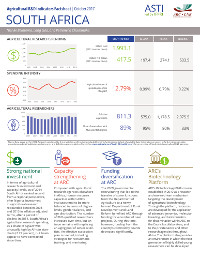
In terms of agricultural research investment and capacity levels, as of 2014 South Africa ranked second from a regional perspective, after Nigeria. Investment in agricultural research rebounded between 2008 and 2013 in inflation adjusted terms, after a period of decline. In 2014, South Africa’s agricultural research spending as a share of AgGDP was unusually high by African standards (2.78 percent), but levels appear to have contracted since then.
Authors:
Lang Gao, Nienke Beintema, and John Momoh
Year:
2017
Publisher
International Food Policy Research Institute and Sierra Leone Agricultural Research Institute
Back to:
Strong investment growth
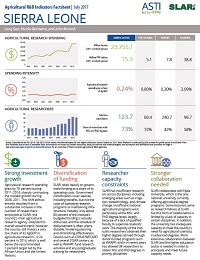
Agricultural research spending grew by 70 percent during 2011–2014, sharply contrasting the modest growth during 2008–2011. This shift almost entirely resulted from a substantial increase in the number of researchers employed at SLARI, the country’s main agricultural research agency. Despite this overall upward trend, however, the country still invests a very low share of its AgGDP in agricultural research—0.24 percent in 2014, which is well below the recommended 1 percent target set by the African Union and the United Nations.
Authors:
Nienke Beintema, Abdullahi Mohammed Nasir, and Lang Gao
Year:
2017
Publisher
International Food Policy Research Institute and Agricultural Research Council of Nigeria
Back to:
Lack of funding diversity
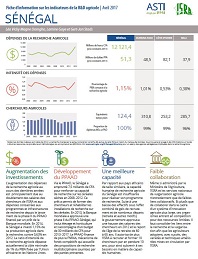
Sénégal : ASTI–ISRA Fiche d’information 2017
Augmentation des investissements
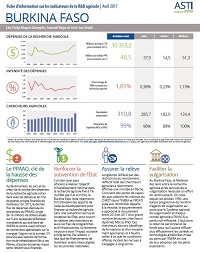
Burkina Faso : ASTI Fiche d’information 2017
Le PPAAO, clé de la hausse des dépenses
Authors:
Léa Vicky Magne Domgho, Samuel Neya, and Gert-Jan Stads
Year:
2017
Publisher
International Food Policy Research Institute
Back to:
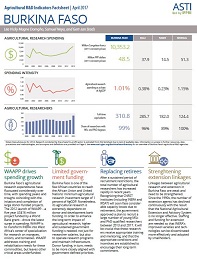
WAAPP drives spending growth
Authors:
Nienke Beintema, Rhoda Mumba, Moses Mwala, and Lang Gao
Year:
2016
Publisher
International Food Policy Research Institute and Zambia Agriculture Research Institute
Back to:
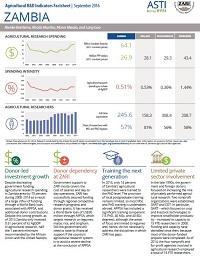
Donor-led investment growth
Despite decreasing government funding, agricultural research spending in Zambia grew by 70 percent during 2008–2014 as a result of a large influx of funding through a World Bank loan, associated with APPSA, and additional donor contributions. Despite this strong growth, as of 2014 Zambia only invested 0.51 percent of its AgGDP in agricultural research, half the 1 percent minimum recommended by the African Union and the United Nations.
Donor dependency at ZARI
Authors:
Nienke Beintema, Patricia Carmichael, and Sandra Perez
Year:
2017
Publisher
International Food Policy Research Institute and Department of Agricultural Research and Specialist Services
Back to:
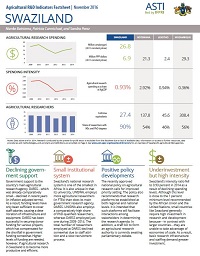
Declining government support
Authors:
Nienke Beintema, Katrina Shiningavamwe, Sheehamandje Ipinge, and Sandra Perez
Year:
2016
Publisher
International Food Policy Research Institute
Back to:
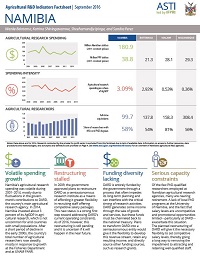
Volatile spending growth
Namibia’s agricultural research spending was volatile during 2001–2014, mostly due to fluctuations in the government’s contributions to DARD, the country’s main agricultural research agency. In 2014, Namibia invested about 3 percent of its AgGDP in agricultural research, which is not uncommon for arid countries with small populations. After a short period of decline in the early 2000s, the country’s total number of agricultural researchers rose steadily, mostly in response to growth at the Fisheries Department and at UNAM-FANR.
Authors:
Nienke Beintema, Sembhoo Chandrabose, and Sandra Perez
Year:
2017
Publisher
International Food Policy Research Institute and Food and Agricultural Research and Extension Institute
Back to:
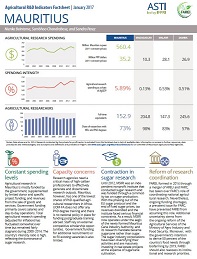
Constant spending levels
Agricultural research in Mauritius is mostly funded by the government, supplemented by limited donor and specific project funding, and revenues from the sale of goods and services. Government funding primarily covers salaries and day-to-day operations. Total agricultural research spending (adjusted for inflation) has fluctuated somewhat over time but remained fairly stagnant during 2000–2014. The country’s intensity ratio is high, reflecting the dominance of sugar research.
Capacity concerns